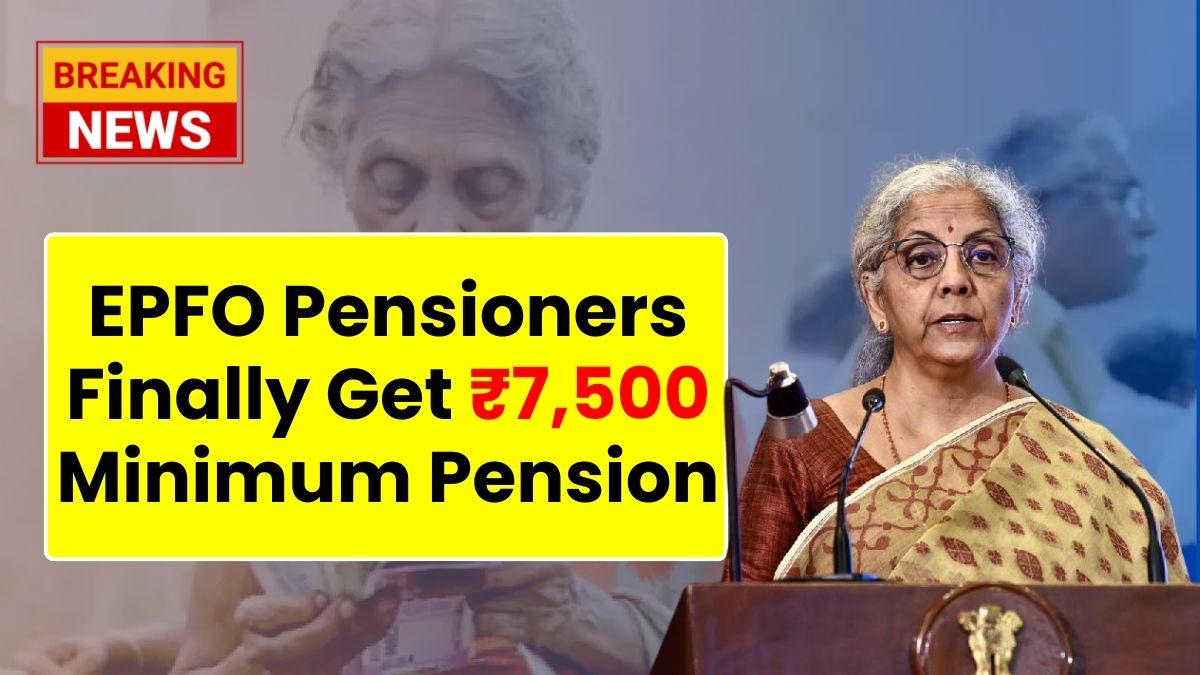
EPFO Pension Update 2026 has become one of the most closely watched topics among retired private-sector employees in India. With rising inflation, expensive medical care, and higher daily living costs, millions of pensioners feel that their current EPS pension is no longer enough to survive with dignity. In this background, reports suggesting a ₹7,500 minimum pension have sparked fresh hope. For many retirees, this update is not just about money—it is about recognition, security, and respect after decades of work.
The Employees’ Pension Scheme was originally designed as a safety net for retirement, but over time, its value has weakened. Many pensioners today receive monthly amounts that barely cover basic needs. The discussion around the EPFO pension update 2026 signals a possible shift in how retirement security is viewed in India, especially for private-sector workers who depend entirely on EPS after retirement.
How the Demand for Pension Revision Reached a Breaking Point
The push for a higher minimum pension did not happen overnight. For years, EPS pensioners have been raising concerns about pensions as low as ₹1,000 to ₹2,000 per month. These amounts may have made sense decades ago, but today they are far from sufficient. As healthcare costs increased and family support structures changed, pensioners found themselves struggling to manage even essential expenses.

Over time, pensioners’ groups organized protests, submitted petitions, and approached courts to demand a fair revision. What changed the tone of the debate was the growing understanding that inadequate pensions are not just a personal problem but a social one. Policymakers began to acknowledge that weak pension systems eventually increase dependency on welfare schemes, family members, and healthcare subsidies.
Why ₹7,500 Is Being Considered a Realistic Minimum Pension
The proposed ₹7,500 minimum pension is not seen as excessive by experts or pensioners. Instead, it is viewed as a basic survival amount in today’s economy. Monthly expenses like rent, electricity, food, transport, and medicines easily cross ₹6,000 in many regions. Anything below that leaves retirees vulnerable to debt or forced dependence.
When adjusted for inflation, the proposed increase is more of a correction than a bonus. Financial analysts argue that EPS pensions have not kept pace with economic realities for years. The ₹7,500 figure reflects the minimum amount required for an independent and dignified retirement, not a luxury lifestyle.

Who Will Benefit the Most from the EPFO Pension Update 2026
If implemented, the biggest beneficiaries will be low-income EPS pensioners, especially those who worked in small private companies, factories, or contractual roles. Many of these retirees contributed regularly during their working years but ended up with extremely low pensions. For them, this update could bring real financial stability for the first time in years.
Family pensioners, including widows and dependents, are also expected to benefit significantly. These households often rely on a single pension amount to manage all expenses. A higher minimum pension would make it easier to handle medical bills, household costs, and emergencies, especially in rural areas where income opportunities are limited.
What This Update Says About the Government’s Policy Direction
Beyond individual relief, the EPFO pension update 2026 sends a strong message about the future of social security in India. It reflects an acknowledgment that pension systems designed decades ago must evolve with changing demographics and economic conditions. With people living longer and healthcare costs rising, retirement planning needs stronger institutional support. At the same time, the government faces the challenge of funding such reforms responsibly. Increasing minimum pensions requires careful financial planning and long-term sustainability. Policy experts believe the ₹7,500 benchmark may be the starting point, with future revisions linked to inflation or contribution structures.

Questions Around Implementation and Timelines
While the proposal has generated optimism, pensioners remain cautious. Past experiences have shown that announcements do not always translate into quick action. Key questions remain around implementation timelines, eligibility criteria, and whether the increase will be phased in gradually. Clear communication from EPFO and the government will be crucial to avoid confusion. Pensioners are especially concerned about arrears, verification processes, and how the new pension amount will be calculated for different categories of retirees. Transparency will play a major role in maintaining trust during rollout.
Changing Public Sentiment Around Retirement Security
Among pensioners, the response to the proposed update has been a mix of relief and guarded hope. Many describe the increase as long overdue rather than generous. Pensioners’ associations have welcomed the discussion while continuing to push for firm commitments and clear deadlines. Interestingly, younger employees are also paying attention. The debate has sparked renewed interest in formal pension systems and long-term financial planning. If the EPFO pension update 2026 becomes reality, it could help restore confidence in EPS as a meaningful retirement support system rather than a symbolic benefit.
What Lies Ahead for EPS Pensioners
If successfully implemented, the ₹7,500 minimum pension could mark a turning point for millions of retirees. It would improve financial independence, reduce reliance on family support, and offer peace of mind during old age. More importantly, it could open the door to future reforms that link pensions to inflation and cost-of-living adjustments. For now, pensioners are watching closely and waiting for official confirmation. The discussion itself shows that sustained collective voices can influence policy—even if change takes time.

Disclaimer
This article is written for general informational purposes and is based on ongoing discussions, media reports, and pensioners’ demands related to EPFO Pension Update 2026. Final decisions, eligibility rules, pension amounts, and implementation timelines will depend on official government notifications and EPFO circulars. Readers are advised to verify all details from authorized government sources before making any financial or retirement-related decisions.